
Improved
6112 HealthChanged
3786 LivesSaved
3568 Lives1 lives impacted in the last 24 hrs Learn More
An True Example On What Can Go Wrong:
A 39 year old female has a lump found below her right ear.
Problem #1: An excision biopsy was done by an ENT without any ultrasound, or fine needle biopsy. It was a papillary thyroid cancer in a level 2 node. The patient was then referred to an endocrinologist. He saw the results of the node biopsy, and told her she needed her thyroid out.
Problem #2: There was no detailed lymph node mapping done before the referral to the surgeon.
Problem #3: The surgeon,knowing there was a proven cancer node high up in the neck removed by the ENT, did not include a modified radical neck on the side of the cancerous node removed.
Problem #4: When the surgeon took out the thyroid cancer, he was confronted with 3 lateral neck nodes that were next to the thyroid. This was his second chance to do a modified neck on that side, but he decided to take the easy way out and only cherry picked the 3 abnormal nodes.
Problem #5: While removing the thyroid with the cancer, he came across 2 very abnormal nodes in the thyroid bed. They were positive for cancer, and again he failed to do the right thing and do a complete central compartment node removal.
Problem #6: After 100 MCI Radioiodine, and a negative whole body scan, she returned with elevated cancer marker, and finally the endocrinologist did an ultrasound lymph node mapping. Surprise, there were more nodes on the side of the twice cherry picked ones.
Problem #7: There was no mention of the central compartment, but we already know the surgeon did not do a good job the first time only taking 2 nodes. There was surely more nodes that were crying out to make the surgeon do a central compartment along with the lateral neck.
Problem #8: Our gun shy surgeon, takes out the lateral nodes, but again fails to address the central compartment.
Problem #9: She returns to the thyroid challenged endocrinologist, and recommends another dose of RAI/131, even though the last one was negative when she had all that cancer in her neck even before the first surgery. Wow, after 165 MCI I/131, and an increased risk of other cancers in the future, her whole body scan was negative!
Well, finally she had enough, and came to me for a second opinion. Even before I touched her neck, I knew she was still full on cancer nodes, especially in the central compartment, because of incomplete first thyroid surgery. There was a large scar all the way to her ear.
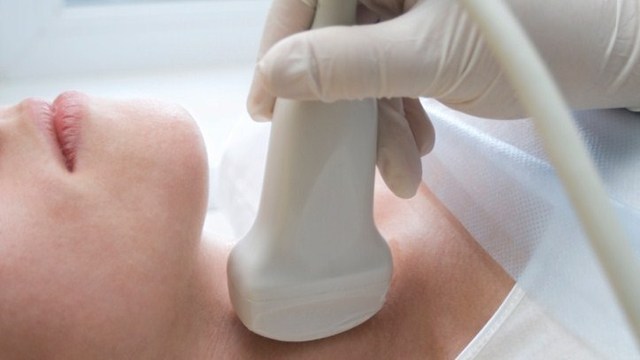
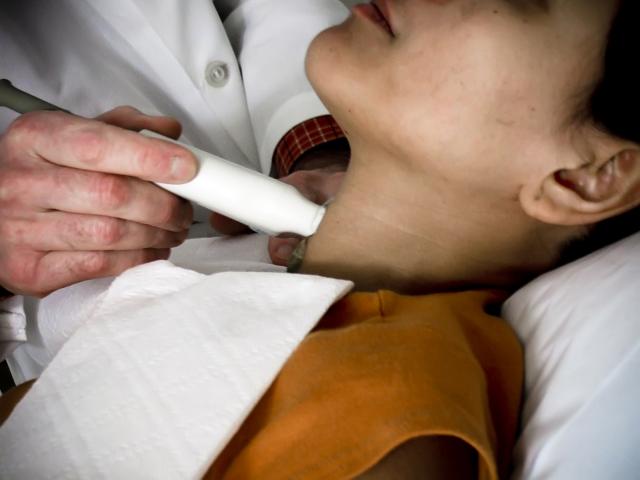
Ultrasound lymph node mapping revealed several abnormal nodes in the thyroid bed. USGFNA of the biggest one was positive for cancer.
Last major problem: After a lymph node excision, a total thyroidectomy with node picking, a lateral neck node surgery, she now needs a 4th surgery to clean out the central thyroid bed. These are the most dangerous, and can only be removed surgically, not with radiation.
What Went Wrong?
Everything, but the most problematic was the failure to do mapping BEFORE the thyroidectomy. All the nodes would have been located, and in addition to a total thyroidectomy, and central compartment node removal, the lateral neck would have been done.
The second problem was the failure to do an FNA on the first node. It would have stopped the first excision surgery, and triggered a extensive investigation of the neck nodes before the first thyroid surgery.
Endocrinologists, and surgeons need to become aware of the crucial role of ultrasound lymph node mapping. Three surgeries, and a fourth one next week, and all this could have been saved by a careful pre-op evaluation before rushing off the OR. One surgery would have been enough.
Finally, the excessive use of radioiodine in a low risk young woman, when surgery was needed, put her at risk for other cancers in the future.
Please, get a second expert's opinion before the first surgery.
Remember, not all endocrinologists are experts in modern thyroid cancer therapy.
They are hard working internists and diabetic specialists, and have little time for modern thyroidology.
It can save you many months of morbitity, and unnecessary radiation, and surgeries.
Good Luck,
Dr.G.
BIO:
Dr. Guttler has been a Thyroid Expert for 31 years, board certified in endocrinology, Clinical Professor of Medicine, Keck School Medicine USC. He was the president of the Academy of Clinical Thyroidologists, www.thyroidologists.com. Dr. Guttler is the director of a world class thyroid center, with capability to do all aspects of thyroid diagnosis, and treatment.
Visit Dr. G at his blog:
http://thyroid.blogspot.com/
To share your thyroid story with EmpowHer, visit
https://www.empowher.com/share.