


Improved
6112 HealthChanged
3786 LivesSaved
3568 Lives0 lives impacted in the last 24 hrs Learn More
When a person has a thyroid nodule, she has a growth of cells within her thyroid gland. This is a common condition. About 50 percent of people in the world have a thyroid nodule, according to Columbia University Medical Center.
The majority of thyroid nodule cases do not cause symptoms, so the thyroid nodule is not detected unless a physician does a routine neck exam.
It is important to have a routine neck exam, as 5 percent of thyroid nodule cases are cancerous, noted Columbia University Medical Center. The diagnostic tools used by physicians will allow them to determine if the nodule is cancerous or not.
The evaluation will start with a physical examination and a review of the patient’s medical history. For example, during the physical examination, the physician will ask the patient to swallow.
This will allow the physician to see if the nodule is in the thyroid gland, as it will move up and down when the patient swallows.
Diagnostics may include thyroid tests, which measure the levels of two thyroid hormones, triiodothyronine (T3) and thyroxine (T4), in the patient’s blood. These tests can also measure the amount of thyroid-stimulating hormone in the blood, which is released by the pituitary gland.
The thyroid tests will indicate if the patient has hypothyroidism or hyperthyroidism.
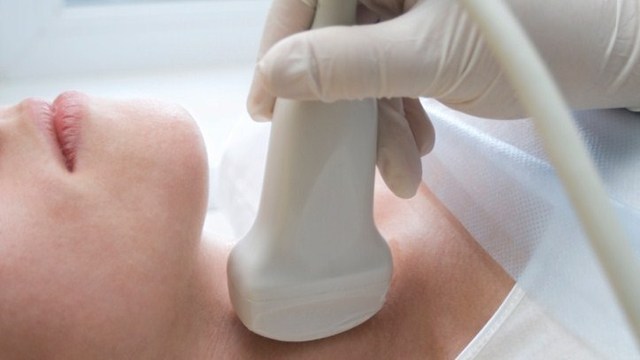
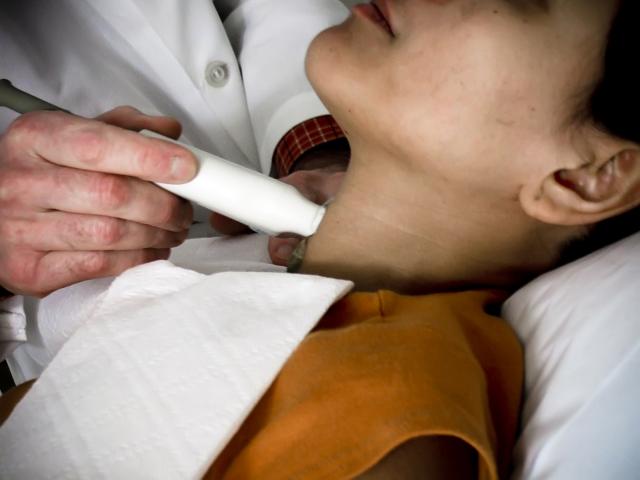
Different imaging techniques allow the physician to get a better view of the patient’s thyroid gland. One option is a thyroid ultrasound, which uses sound waves to create a picture of the thyroid. A thyroid ultrasound can help the physician determine if the thyroid nodule is fluid-filled, solid or complex.
The MayoClinic.com noted that a thyroid ultrasound can serve as a guide when performing a fine-needle aspiration, which is another diagnostic tool used to diagnose a thyroid nodule. With a fine-needle aspiration biopsy, the physician inserts a thin needle into the patient’s thyroid nodule to extract a sample of cells.
A physician may also order a radioactive iodine scan, which uses a radioiodine to show the thyroid gland’s function. With this diagnostic test, the patient ingests a small quantity of radioiodine or is injected with the tracer.
Afterward, the patient lies on a table while a specialized camera creates a computerized image of the thyroid. This image will show either a “hot” thyroid nodule or “cold” thyroid nodule, which differ by concentration of radioactive iodine.
Columbia University Medical Center noted that “hot” thyroid nodules are rarely cancerous, while “cold” thyroid nodules are cancerous in up to 10 percent of cases.
References
Columbia University Medical Center. Thyroid Nodules. Web. 24 January 2012
http://www.cumc.columbia.edu/dept/thyroid/nodules.html
MayoClinic.com. Thyroid Nodules. Web. 24 January 2012
http://www.mayoclinic.com/health/thyroid-nodules/DS00491/METHOD=print
MedlinePlus Medical Encyclopedia. Thyroid Nodule. Web. 24 January 2012
http://www.nlm.nih.gov/medlineplus/ency/article/007265.htm
Reviewed January 24, 2012
by Michele Blacksberg RN
Edited by Jody Smith
Add a CommentComments
There are no comments yet. Be the first one and get the conversation started!