


Improved
6113 HealthChanged
3786 LivesSaved
3568 Lives0 lives impacted in the last 24 hrs Learn More
 Photo: Getty Images
A common eye disorder, astigmatism occurs when there is an irregular curvature in the cornea, which is the front surface of the eye. As a result, some of the areas of the cornea are steeper, while others are flatter.
The American Optometric Association added that in some cases, the astigmatism results from irregular curvature of the lens, which is inside the eye. With the irregular curvature, light refraction is altered, causing the patient to have blurred vision.
The University of Michigan Kellogg Eye Center noted that some experts think that the majority of people have a degree of astigmatism, which can start as early as birth. Some people develop astigmatism after having surgery on the eye, such as with cataract surgery.
Patients with astigmatism have blurred vision at all distances. Often, a patient with astigmatism can have another eye disorder, such as hyperopia (farsightedness) and myopia (nearsightedness).
Besides the blurred vision, patients can also experience headaches, squinting, eye strain and discomfort, and fatigue. The National Eye Institute added that patients with astigmatism can have difficulty driving at night.
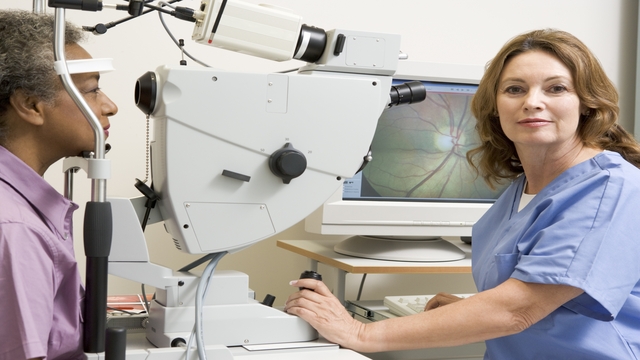
To diagnose astigmatism, the doctor will measure the light reflected from the cornea and measure the curvature of the cornea. To measure reflected light, the doctor will use a keratometer, which also measures the orientation of the astigmatism. A keratoscope is used to measure the curvature and allows the doctor to see the degree of the curvature.
Several treatment options are available for astigmatism. If a patient’s astigmatism is minor and she does not have hyperopia or myopia, the University of Michigan Kellogg Eye Center noted that she may not need corrective lenses. If astigmatism does cause symptoms that interfere in the patient’s life, such as headaches and eyestrain, then the doctor may recommend corrective lenses.
Patients may choose to wear eyeglasses or contact lenses. The type of corrective lenses used specifically for astigmatism are called toric lenses. The National Eye Institute stated that eyeglasses are the safest treatment for astigmatism, though contact lenses are safe if the patient has them fitted and if she uses them properly.
Some patients may undergo a procedure called orthokeratology, which involves wearing rigid contact lenses to correct the eye’s curvature. These lenses are worn several hours a day until the curvature improves, then the patient is able to wear them less frequently. The MayoClinic.com warned that patients who no longer wear the lenses are at risk for the eye to return to the former curvature.
Surgery may be done to reshape the cornea. Options include laser-assisted in-situ keratomileusis (LASIK) surgery, laser-assisted subepithelial keratomileusis (LASEK) and photorefractive keratectomy (PRK). Patients should talk to their doctors to decide what surgical option is best for them.
References
National Eye Institute. Astigmatism. Web. 26 September 2011
http://www.nei.nih.gov/healthyeyes/astigmatism.asp
University of Michigan Kellogg Eye Center. Astigmatism. Web. 26 September 2011
http://www.kellogg.umich.edu/patientcare/conditions/astigmatism.html
MedlinePlus Medical Encyclopedia. Astigmatism. Web. 26 September 2011
http://www.nlm.nih.gov/medlineplus/ency/article/001015.htm
American Optometric Association. Astigmatism. Web. 26 September 2011
http://www.aoa.org/Astigmatism.xml
MayoClinic.com. Astigmatism. Web. 26 September 2011
http://www.mayoclinic.com/health/astigmatism/DS00230/METHOD=print
Reviewed September 26, 2011
by Michele Blacksberg RN
Edited by Jody Smith
Add a CommentComments
There are no comments yet. Be the first one and get the conversation started!