





Improved
6141 HealthChanged
3797 LivesSaved
3584 Lives0 lives impacted in the last 24 hrs Learn More
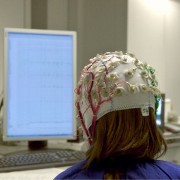 Photo: Getty Images
A pilot study involving a non-invasive test to evaluate autism risk in infants had an 80 percent accuracy rate in identifying those infants at high risk. This test uses the electroencephalogram (EEG) in conjunction with machine-learning algorithms. The algorithms discern patterns in the EEG results that might otherwise be missed.
This study was done at Children's Hospital Boston. The research was published on February 22, 2011 online in the journal BMC Medicine.
Brain waves are the electrical activity of the brain. EEGs can record this activity through the use of electrodes that have been attached to the child's head.
For a long time, EEG tests have been used to identify those children with epilepsy, and who also have autism. Children with autism display a higher rate of epilepsy than the rest of the population.
EEGs can be useful in detecting the differences between the brain waves of children who have autism, and those who do not. So EEGs are no longer just used to assess seizure activity in epileptics, they can now also be used to detect the differences between the two types of brain waves.
EEGs have been used to evaluate brain waves of a person at rest. Now they are also being used to record brain waves after sensory stimuli. EEGs can also read what parts of the brain are in communication with each other, as well which parts of the brain are emitting various types of brain waves.
EEG testing is considered to be completely safe for the children tested, and can be done without sedation unlike an MRI. The test is painless and can be done easily in just a few minutes in a doctor's office.
Another advantage of the EEG is that it helps in being able to differentiate between autism and attention deficit hyperactivity disorder (ADHD). These two conditions are sometimes misdiagnosed for each other.
Either condition can be characterized by outbursts of temper and withdrawal from the giving and receiving of physical expressions of affection. Children with both of these disorders may be extremely sensitive to such external stimuli as textures of clothing, noise and visual input. Children with either autism or ADHD may have difficulties in auditory processing.
It is hoped that the information will help identify differences in the brain's function and organization at a very early stage of autism, allowing for intervention up to two years sooner than a diagnosis might otherwise be reached.
Resources:
Using EEGs to Diagnose Autism Spectrum Disorders in Infants: Machine-Learning System Finds Differences in Brain Connectivity
http://www.sciencedaily.com/releases/2011/02/110222082730.htm
Epilepsy and EEG paroxysmal abnormalities in autism spectrum disorders.
http://www.ncbi.nlm.nih.gov/pubmed/20691552
Pinpointing an Elusive Diagnosis: ADHD or Autism?
http://health.msn.com/health-topics/adhd/articlepage.aspx?cp-documentid=100220023
ADHD Autistic Symptoms
http://www.ehow.com/facts_4970389_adhd-autistic-symptoms.html
Visit Jody's website and blog at http://www.ncubator.ca and http://ncubator.ca/blogger
Add a CommentComments
There are no comments yet. Be the first one and get the conversation started!