




Improved
6112 HealthChanged
3786 LivesSaved
3568 Lives0 lives impacted in the last 24 hrs Learn More
 vchalup/fotolia
Skin cancer, malignant tumors that form in the tissue of the skin, can take on many shapes, sizes and colors and may present itself with different symptoms in different people. However, there are some common symptoms everyone should be aware of because anyone can get skin cancer.
With each of the three most common types of skin cancer — basal cell carcinoma (BCC), squamous cell carcinoma (SCC), and melanoma — itchy lesions are possible, but not likely.
It is more common for skin cancer to bleed than itch. More often you’ll find that the itchy patches are non-malignant and are something like psoriasis, eczema or ringworm.
Skin cancer is very common. It is the most diagnosed type of cancer in the United States. More than 68,000 Americans are diagnosed with melanoma, and another 48,000 are diagnosed with an early form of the disease that involves only the top layer of skin.
In addition, more than 2 million people are treated for basal cell or squamous cell skin cancer each year. Basal cell skin cancer is several times more common than squamous cell skin cancer, according to the National Cancer Institute, part of the Institutes of Health.
Basal cell carcinoma.
BCC begins in the basal cell layer of the skin. It usually occurs in places that have been in the sun. For example, the face is the most common place to find basal cell skin cancer, but it may appear on the scalp, neck, hands, and arms.
In people with fair skin, BCC is the most common type of skin cancer.
BCC often grows slowly. It may look like a:
• Reddish patch of dry skin that won’t heal
• Flesh-colored (or pink, red, or brown) pearl-shaped lump
• Pimple that just won’t clear
• Sore that bleeds, heals, and then returns
• Scar that feels waxy — may be skin-colored, white, or yellow
• Group of slow-growing, shiny pink or red growths — look like sores, often scaly and bleed easily
• Flat or sunken growth — feels hard, may be white or yellow
Squamous cell carcinoma.
This is a very common type of skin cancer. It often appears on skin that got lots of sun, such as an ear, face, bald scalp, neck, or arm. But it can appear elsewhere — even inside the mouth, on the lip, or on the genitals.
Too much sun is often the cause, but it is not the only cause. SCC can appear on skin that was badly burned, had lots of radiation (such as x-rays), or was exposed to strong chemicals.
SCC often has a reddish color. Without treatment, it can grow deeply. If this happens, the cancer can spread to other parts of the body. This can be deadly. SCC often looks like a:
Melanoma.
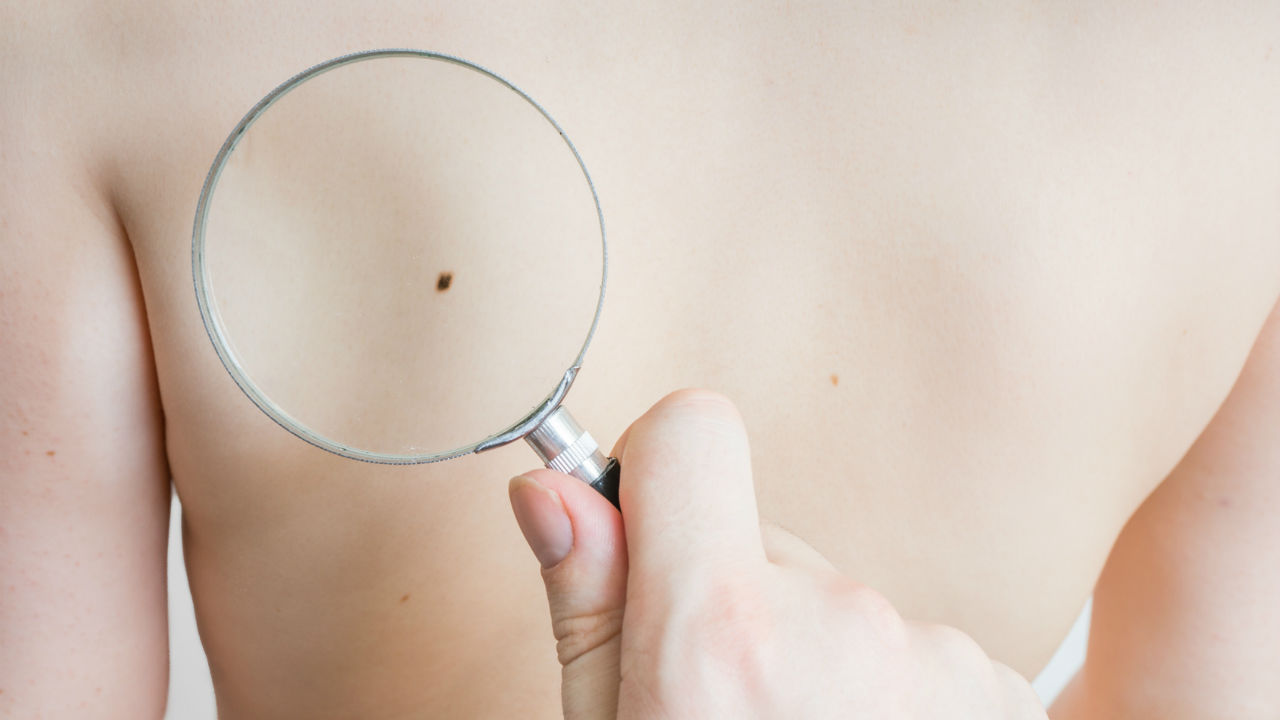
Melanoma often appears in an existing mole or looks like a new mole. By knowing where you have moles on your skin, you can find melanoma when it first appears.
Although melanoma is the most deadly of these three types of skin cancer, when treated early, melanoma is often curable.
In more advanced melanoma, the texture of the mole may change. The skin on the surface may break down and look scraped. It may become hard or lumpy. The surface may ooze or bleed. Sometimes the melanoma is itchy, tender, or painful.
Here’s what to looks for:
• A mole on the skin that is growing, changing shape, or changing color
• A mole that looks scaly, oozes, or bleeds
• New dark spot on the skin that looks like a mole, but grows quickly
• Pain, itch, or bleeding in a new spot on the skin
• Streak (usually brown or black) underneath a fingernail or toenail
• Bruise on the foot that does not heal
There are also other less common types of skin cancer. For example, cutaneous T-cell lymphoma (CTCL) is the most common type of lymphoma, a blood cancer, involving the skin that typically presents with red, scaly patches or thickened plaques of skin that often mimic eczema or chronic dermatitis.
This type of skin cancer can cause tumors that can cover up to 80 percent of the body and typically do itch and can become infected, according to the Cutaneous Lymphoma Foundation.
The best way to tell if you have skin cancer is to see a dermatologist. You should see a dermatologist right away for a skin cancer check if you see anything on your skin that lasts for two weeks or longer and is growing, changing shape, bleeding or itching.
The American Academy of Dermatology offers free skin cancer screenings throughout the year. The professional organization also can help you find a dermatologist in your area.
http://www.aad.org/
Lynette Summerill is an award-winning writer and Scuba enthusiast living in San Diego, CA with her husband and two beach loving dogs. In addition to writing about cancer-related issues for EmpowHER, her work has been seen in newspapers and magazines around the world.
Sources and Patient Information:
National Cancer Institute. Online booklet, “What you need to know about Melanoma and other skin cancer. http://www.cancer.gov/cancertopics/wyntk/skin/page1
Skin Cancer. Medline Plus Medical Dictionary accessed online http://www.nlm.nih.gov/medlineplus/ency/article/000829.htm
American Academy of Dermatology. Skin Cancer. Access online at: http://www.aad.org
Cutaneous Lymphoma Foundation http://www.clfoundation.org/about-cutaneous-lymphoma
Reviewed February 21, 2012
by Michele Blacksberg RN
Edited by Jody Smith
Add a Comment8 Comments
"The best way to tell if you have skin cancer is to see a dermatologist" This is probably the most obnoxious thing to read when using the internet as a tool.
December 14, 2015 - 9:29amThis Comment
I think that sometimes the doctors leap at the quickest explanation instead of spending time analyzing what they find. I think it's possible too be diagnosed with squamous cell and actually have a form of psoriasis. Particularly if you are fair complexion and have relatives who have psoriasis, even if you've never had it. I am not at all impressed with the lack of thought that dermatologists put into diagnosing. The pathologist's report that came back on my biopsy had the words "thank you" handwritten beautifully on the report. To this day I am amazed and also extremely suspicious of that biopsy. That dermatologist was to use the vernacular, "flakey" and our area is devoid sun for many months of the year but she claimed to diagnose twelve cases of skin cancer a day.
July 21, 2015 - 12:01amThis Comment
This article should be removed as many will think that an itchy lesion is nothing to worry about. I had a basal cell carcinoma and a squamous that itched like crazy - in fact that was the ONLY symptom other than the lesion itself. Skin cancer DOES, in fact, itch and it's incredibly common. Please get any new lesions on your skin checked by your doctor - basal cell usually does not spread to organs, but it does spread under your skin. The results can be devastating and highly disfiguring.
March 29, 2015 - 6:32amThis Comment
This is misleading. I had a mole that itched like crazy, never bled. But because all these articles claim that cancer doesn't itch, I never had it checked. Ten years I went with this itchy mole. I finally had it removed just to stop the annoyance. It came back as basal cell carcinoma. My mole also doesn't look anything like all the cancerous mole pics you see on the internet. If you have a mole that bothers you, get it checked! Don't trust the internet.
January 19, 2015 - 12:52pmThis Comment
you are so correct. I had a spot on my back that kept itchy and for a year I put up with it. it got so bad I went to the doctor and he said oh its nothing I will freeze it. weeks later it still itched. went to see another doctor and they said it was nothing. finally I went to a doctor referred to me by my daughter and he took a sample and it was skin cancer. so he took a bigger piece out and said he thinks he got it all. now 9 months later it is starting to itch again next to the spot so I will go back and get it checked to see why.
October 12, 2017 - 4:46amThis Comment
I was first diagnosed with malignant melanoma 12 years ago. I have had several surgeries and continue to have new spots develop. Itching is the main symptom I experience every time and my dermatologist indicates that itching is a common symptom. You should be careful about making a claim that this is not common.
June 26, 2013 - 11:59amThis Comment
Thank you for letting us know about the itching. I have a spot that itches so badly at times.
January 21, 2014 - 2:49pmThis Comment
i think yes....
October 12, 2012 - 9:03amThis Comment