





Improved
6113 HealthChanged
3786 LivesSaved
3568 Lives0 lives impacted in the last 24 hrs Learn More
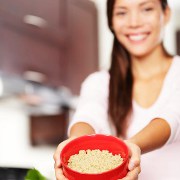 Photo: Getty Images
Information about what gluten can do to people with a gluten sensitivity, and how avoiding gluten can set them free, is transforming lives. The concept of avoiding gluten not so long ago automatically led to the assumption that cutting out gluten also met cutting out all baked goods or grain products.
For some, this was followed with a resignation to living with unpleasant symptoms. For others, it led to a brave sacrifice of a wide swath of foods from their diets.
But the choice doesn't necessarily have to be either / or. Turns out, even if you have celiac disease or gluten sensitivity, you can have your cake and eat it too. As it turns out, there are grains and grain substitutes that won't hurt celiac disease sufferers and those with gluten intolerance.
Quinoa (pronounced "keen-wah") is one of these wonder (short for "wonderful!", as in "it's wonderful to be able to eat!") foods.
About.com has said that quinoa isn't actually a grain, but rather is a seed from a plant related to spinach. Other sources disagree on this point, calling it a grain. Grain or no grain, however, quinoa can replace grain nicely in your cooking and food preparation.
Quinoa contains no gluten. It has a high fiber content, and contains all the essential amino acids so it offers complete protein. Vegetarians and vegans will be happy to hear this.
Quinoa has hefty amounts of copper, iron, phosphorus, lysine, magnesium and manganese.
Wisegeek.com opines that quinoa tasts a little nutty. It's similar to millet, according to Celiac.com, and can be used as you would use couscous or rice.
Unmilled quinoa flour is coarser and more nutrient-dense that its milled quinoa flour counterpart which is smoother. Some quinoa flours may be contaminated with gluten, depending on how it has been processed.
It's important to be aware that some products that contain quinoa may still have gluten in them. Be sure to read your package labels and lists of ingredients.
If you've done your homework and made sure gluten is not an ingredient or possible contaminant, then quinoa pasta, quinoa breakfast cereal and quinoa flour all are safe for someone with celiac disease or gluten intolerance.
Storing quinoa flour in the refrigerator or freezer will prolong its usability, otherwise it can go bad in a short time at room temperature.
Quinoa flour has a protein content of about 17 percent according to Wisegeek.com, and also is high in fiber. The protein content is so high in fact that mixing it with other flours is often recommended. Otherwise baked items can be heavy and sticky.
A combination of quinoa, potato starch, sorghum and tapioca provides a nice balance, and can turn out some highly edible baked goods. Of course, you can always try out different variations to suit your taste.
Sources:
Quinoa the Amazing Gluten-Free Grain
http://www.celiac.com/articles/21825/1/Quinoa-the-Amazing-Gluten-Free-Gr...
Is quinoa gluten-free? Updated Oct. 26, 2011.
http://celiacdisease.about.com/od/glutenfreegrains/f/Is-Quinoa-Gluten-Fr...
What is Quinoa Flour?
http://www.wisegeek.com/what-is-quinoa-flour.htm
Visit Jody's website and blog at http://www.ncubator.ca and http://ncubator.ca/blogger
Reviewed December 7, 2011
by Michele Blacksberg RN
Add a CommentComments
There are no comments yet. Be the first one and get the conversation started!