

Improved
6112 HealthChanged
3786 LivesSaved
3568 Lives0 lives impacted in the last 24 hrs Learn More
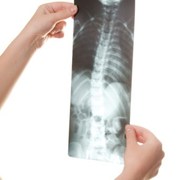 Photo: Getty Images
Scoliosis is a curve away from the middle or sideways of the spine. It can be a congenital condition, which means it's present from birth. It might be a neuromuscular condition, which means it involves the nervous system and the muscles. Or it may be idiopathic, which is another way of saying its cause is not known.
Congenital scoliosis is often associated with other birth defects. Neuromuscular scoliosis often is accompanied by other disorders such as muscular dystrophy or cerebral palsy.
Every spine is supposed to have some curves. Nobody's spine is straight up and down. But with scoliosis, the spine curves in a shape reminiscent of an "S" or a "C".
Scoliosis may not be visible to the casual observer depending on its severity, and subtle curves may not have much effect on day to day life. One indication of possible scoliosis is a shoulder that is higher than the other, or a tilt to the pelvis.
Someone with scoliosis may experience back pain, or fatigue. Sitting or standing for any length of time can cause fatigue and pain.
Mild cases of scoliosis may only cause some low back pain. Someone with a mild curve may only need to be monitored through regular checkups, in case the scoliosis increases.
The bigger the curve, though, the greater the impact on the sufferer. Scoliosis where the curve is more than 100 degrees can have a negative effect on breathing.
An orthopedist is a doctor who specializes in preventing or correcting problems of the bones, and related problems with the muscles, joints and ligaments. An orthopedic surgeon specializes in bones, joints, ligaments, muscles, nerves and tendons.
The orthopedist can assess how much of a curve the spine has by measuring the curve, and with X-rays. An orthopedist may recommend braces when the curve is more than 25 or 30 degrees in a child.
A child who is still growing can be vulnerable to the possibility of a worsening curve. Braces may be the best choice for this situation.
Surgery is usually not used until after a child has stopped growing. However, in extreme cases of scoliosis that is becoming worse, an orthopedic surgeon may opt to go ahead with surgery, especially for curves that are 40 degrees or more.
Surgery fuses together the bones where the curve is located. Metal rods held in place by screws and hooks hold the bones together until after they have healed. Entry may be through the abdomen, the back, or below the ribs.
After the surgery, a brace may be used to reinforce integrity of the spine. Braces don't correct curves but they can keep the curve from getting more extreme. And braces will help to hold the spine in a better position.
Sometimes braces are only needed for night-time use. In other cases, braces need to be worn through the day and the night.
Sources:
Scoliosis. Ncbi.nlm.nih.gov. Retrieved Nov. 2, 2011.
http://www.ncbi.nlm.nih.gov/pubmedhealth/PMH0002221
Scoliosis. Kidshealth.org. Retrieved Nov. 2, 2011.
http://kidshealth.org/kid/health_problems/bone/scolio.html
Orthopedist. Thefreedictionary.com. Retrieved Nov. 2, 2011.
http://www.thefreedictionary.com/Orthopedist
Orthopedic Surgeon. Jobprofiles.org. Retrieved Nov. 2, 2011.
http://www.jobprofiles.org/heaorthopedic.htm
Visit Jody's website and blog at http://www.ncubator.ca and http://ncubator.ca/blogger
Reviewed November 3, 2011
by Michele Blacksberg RN
Add a CommentComments
There are no comments yet. Be the first one and get the conversation started!